How to Write a Professional Resume Summary
Written from a recruiter’s desk — for freshers, experienced professionals, and career switchers.
The top third of your resume decides your fate.
That’s where I look first. Every recruiter does. And most people waste it on a tired line like “Hardworking professional seeking a challenging role to utilize my skills.”
I’ve read that sentence ten thousand times. It tells me nothing. It could belong to anyone. When I see it, my eyes glaze and I move on.
A good resume summary does the opposite. In three lines, it tells me who you are, what you’re great at, and why I should keep reading. Let me show you how to write one.


Quick Answer: What Is a Resume Summary?
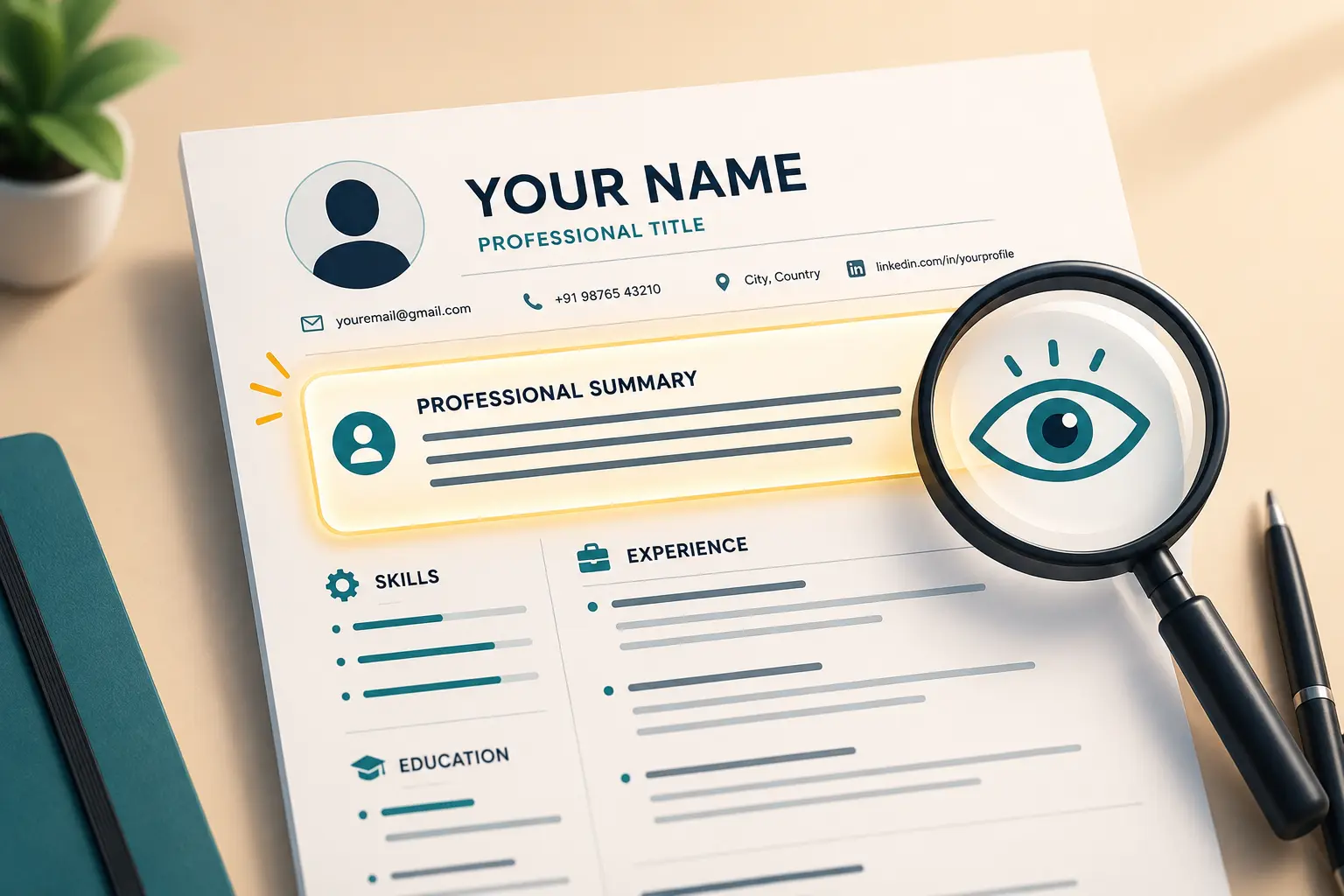
A resume summary is a 2–4 line paragraph at the top of your resume that highlights your strongest skills, experience, and achievements. It sits just below your name and contact details, and its job is simple: make a busy recruiter want to read the rest. Think of it as your 7-second pitch.
Why It Matters More Than You Think
Recruiters spend roughly 7 seconds on a resume on the first pass, according to Ladders’ eye-tracking research. Your summary is what they read in those seconds.
Get it right, and they slow down to read your experience. Get it wrong — or use a generic objective — and they skim past you toward the next candidate.
After reviewing thousands of resumes, one pattern is clear: the strongest summaries are specific. They name a role, a number, and a strength. The weak ones hide behind buzzwords like “dynamic,” “results-oriented,” and “team player.”
📌 Recruiter Tip: Write your summary last. Finish your experience and skills sections first, then pull your three best highlights up to the top. It’s far easier than staring at a blank line.
The 3-Line Formula That Works
Every strong summary follows the same simple structure:
Line 1: Who you are + years of experience + your field. Line 2: Your biggest achievement, with a number. Line 3: A key skill or tool + what you’re aiming for.
That’s it. Role, proof, direction. Keep it under 60 words.
⚠️ Warning: Summary ≠ Objective. An objective says what you want (“seeking growth and learning”). A summary says what you offer. Recruiters hire for value, not for your wish list. Lead with what you bring, not what you’re looking for. The only time an objective still works is for a total career switch — and even then, keep it short.
Copy-Paste Templates (Fill in the Blanks)
Steal these. Replace the brackets with your real details.
Experienced professional:
[Job title] with [X] years of experience in [industry]. [Verb + biggest achievement with a number]. Skilled in [2–3 tools/skills], now seeking a [target role] to [value you’ll add].

Fresher / recent graduate:
[Degree] graduate with hands-on experience through [internship/project]. [Achievement or project result with a number]. Strong in [2–3 skills], eager to contribute as a [target role].
Career switcher:
[Current role] transitioning into [new field], bringing [X] years of transferable [skill]. [A relevant win or completed certification]. Now applying [transferable strength] to [new target role].

Real Before → After Examples
See how the formula transforms a flat summary into one that earns a second look.
Experienced (Sales)
- Before: “Hardworking sales professional looking for a good opportunity to grow.”
- After: “Sales manager with 7 years in B2B SaaS. Grew regional revenue 35% and led a 6-person team to exceed quota three years running. Skilled in Salesforce and pipeline strategy, seeking a senior sales role at a remote-first company.”
Fresher (Marketing)
- Before: “Enthusiastic graduate seeking a marketing role to apply my knowledge.”
- After: “Marketing graduate with internship experience running social campaigns. Grew a college fest’s Instagram to 5,000 followers in two months. Skilled in Canva and Meta Ads, eager to join a digital marketing team.”
Career Switcher (Teacher → L&D)
- Before: “Teacher wanting to move into the corporate sector.”
- After: “Educator with 5 years’ experience moving into Learning & Development. Designed and delivered training for 200+ students and completed an L&D certification. Applying instructional skills to corporate training roles.”
💡 Pro Tip: Mirror the job. Read the job description, note the exact title and top 2 skills they ask for, and echo that language in your summary. When a recruiter sees their own words reflected back, you instantly read as “a match.”
The Mistakes That Sink Summaries
| Mistake | Why It Hurts | Fix |
|---|---|---|
| Generic buzzwords (“dynamic,” “hardworking”) | Says nothing, blends in | Use a specific number or result |
| Writing an objective instead | Focuses on you, not value | Lead with what you offer |
| Too long (a full paragraph) | Recruiter won’t read it | Keep it 2–4 lines, under 60 words |
| Same summary for every job | Reads as mass-applied | Tailor the title and skills each time |
| No numbers | Sounds like a claim | Add one metric — people, %, or money |
Your 4-Step Action Plan
- Finish the rest of your resume first. Then pick your three strongest highlights.
- Use the formula: role → achievement with a number → skill + target.
- Cut every buzzword. If “dynamic” or “results-oriented” appears, delete it.
- Tailor it to each job’s title and top skills before you apply.
Ten minutes. One strong summary. Far more replies.
Ready to write yours? Create an ATS-friendly resume using Smart Resume Studio on WorkAnywhere.in — it helps you build a summary recruiters actually read — and improve your chances of getting shortlisted for your next opportunity.
Key Takeaways
- Your summary is your 7-second pitch — the first thing recruiters read.
- Follow the formula: role + achievement with a number + skill and target.
- Write a summary (what you offer), not an objective (what you want).
- Cut buzzwords; add one real number instead.
- Tailor the title and skills for every application.

Frequently Asked Questions
What is a good resume summary? A good resume summary is 2–4 lines that state your role and experience, one achievement backed by a number, and a key skill tied to the job you want. It’s specific, tailored, and focused on the value you offer.
How long should a resume summary be? Two to four lines, or under 60 words. It should be short enough to read in a few seconds but specific enough to make a recruiter want to read your full resume. Cut anything vague.
What is the difference between a resume summary and an objective? A summary highlights what you offer — your skills and achievements. An objective states what you want from the job. Recruiters prefer summaries because they focus on value. Use an objective only for a major career switch.
Should freshers write a resume summary? Yes. Freshers can summarize internships, projects, and key skills instead of work history. For example: “Marketing graduate with internship experience; grew a campaign’s reach 3x.” Real projects and numbers count.
Do I need a different summary for each job? Ideally, yes. Adjust the job title and top skills to match each job description. A tailored summary signals you’re a genuine match, while a generic one signals a mass application. It takes only a minute.
What words should I avoid in a resume summary? Avoid empty buzzwords: “hardworking,” “dynamic,” “results-oriented,” “team player,” and “seeking a challenging role.” They say nothing specific. Replace them with a real number or a concrete achievement.
More from Remote Guide