50 Resume Action Verbs That Impress Recruiters
Written from a recruiter’s desk — for freshers, experienced professionals, and career switchers.
I once read two resumes for the same role, back to back. Same degree. Same years of experience. Almost the same job.
The first one said: “Responsible for handling the sales team.” The second said: “Led a 6-person sales team to a 30% revenue jump in one year.”
I called the second candidate that afternoon. The first? I don’t even remember their name.
The difference wasn’t talent. It was one word — a weak verb versus a strong one. That’s what this guide fixes.

Quick Answer: What Are Resume Action Verbs?
Resume action verbs are strong, specific verbs that begin a bullet point and describe what you actually did — like led, built, launched, or increased. They replace weak phrases like “responsible for” or “worked on,” making your achievements sound active, confident, and results-driven. Recruiters scan for them because they signal impact, not just duties.

Why Weak Verbs Kill Good Resumes
Recruiters don’t read resumes. They scan them. Eye-tracking research from Ladders found the average recruiter spends roughly 7 seconds on a resume on the first pass.
In 7 seconds, “responsible for” tells me nothing. Everyone is responsible for something. But “cut costs 18%” or “trained 40 new hires” — those pull my eye and make me stop.
After reviewing thousands of resumes, one mistake appears on almost every weak one: candidates describe duties instead of results. Strong verbs force you to show the result. That’s their real power — they change how you think about your own work.
📌 Recruiter Tip: Start every bullet with a verb, never with “I” or “Responsible for.” Ten bullets, ten strong verbs, ten results. That’s a resume that gets calls.
The 50 Action Verbs, Sorted by What You Did
Pick the verb that matches your real contribution. Don’t just swap in a fancy word — match it to the truth.

| Category | Action Verbs |
|---|---|
| Led / Managed | Led, Directed, Managed, Oversaw, Coordinated, Supervised, Mentored, Guided |
| Built / Created | Built, Designed, Developed, Launched, Established, Created, Engineered, Produced |
| Improved / Grew | Increased, Improved, Boosted, Accelerated, Optimized, Streamlined, Scaled, Strengthened |
| Achieved / Delivered | Achieved, Delivered, Exceeded, Won, Secured, Generated, Drove, Completed |
| Saved / Reduced | Reduced, Cut, Saved, Eliminated, Minimized, Decreased, Consolidated |
| Solved / Analyzed | Solved, Resolved, Analyzed, Identified, Diagnosed, Researched, Evaluated |
| Communicated / Influenced | Presented, Negotiated, Persuaded, Trained, Advised, Collaborated, Championed |
That’s 50 verbs. Bookmark this table — you’ll come back to it every time you update your resume.
Before → After: See the Difference
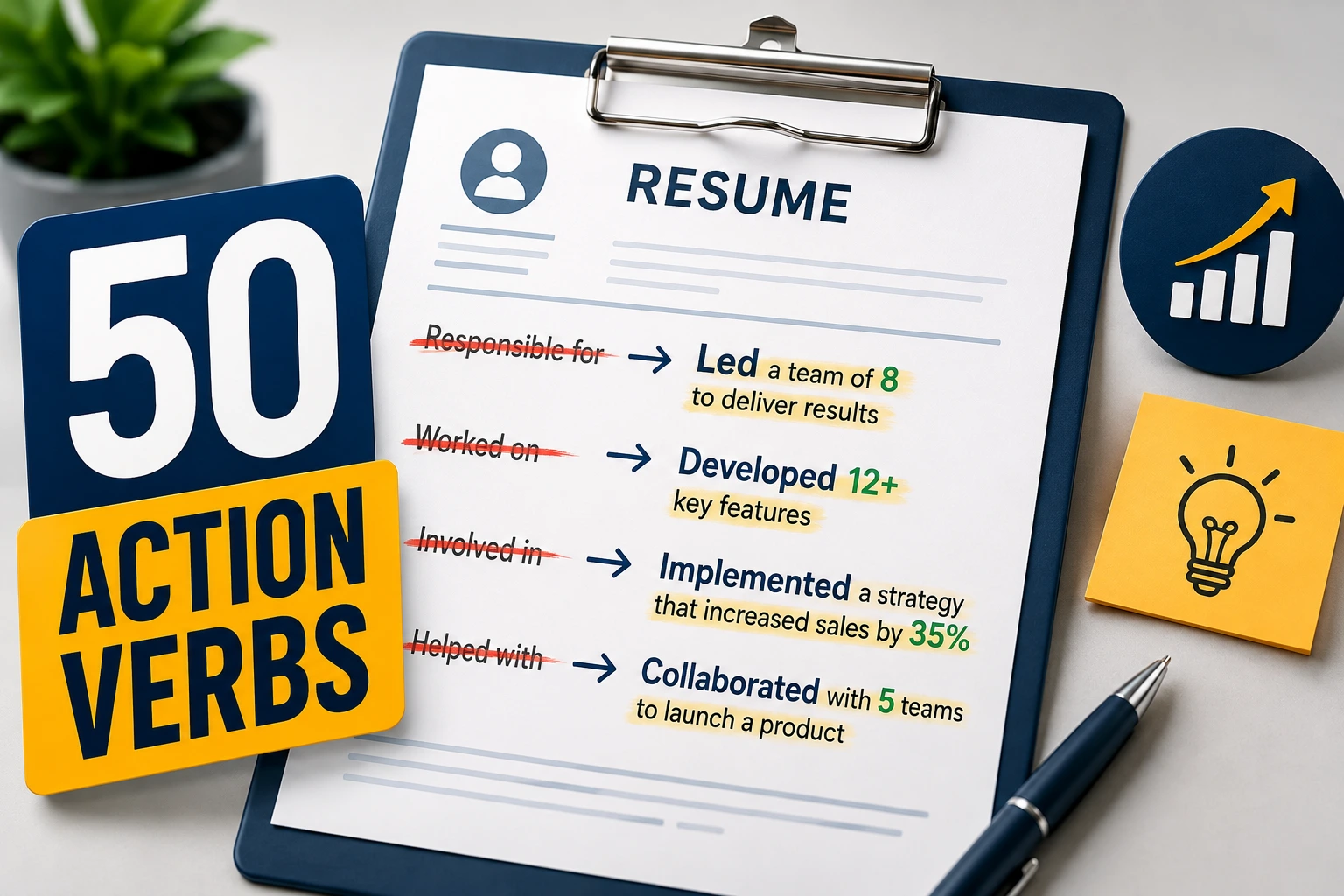
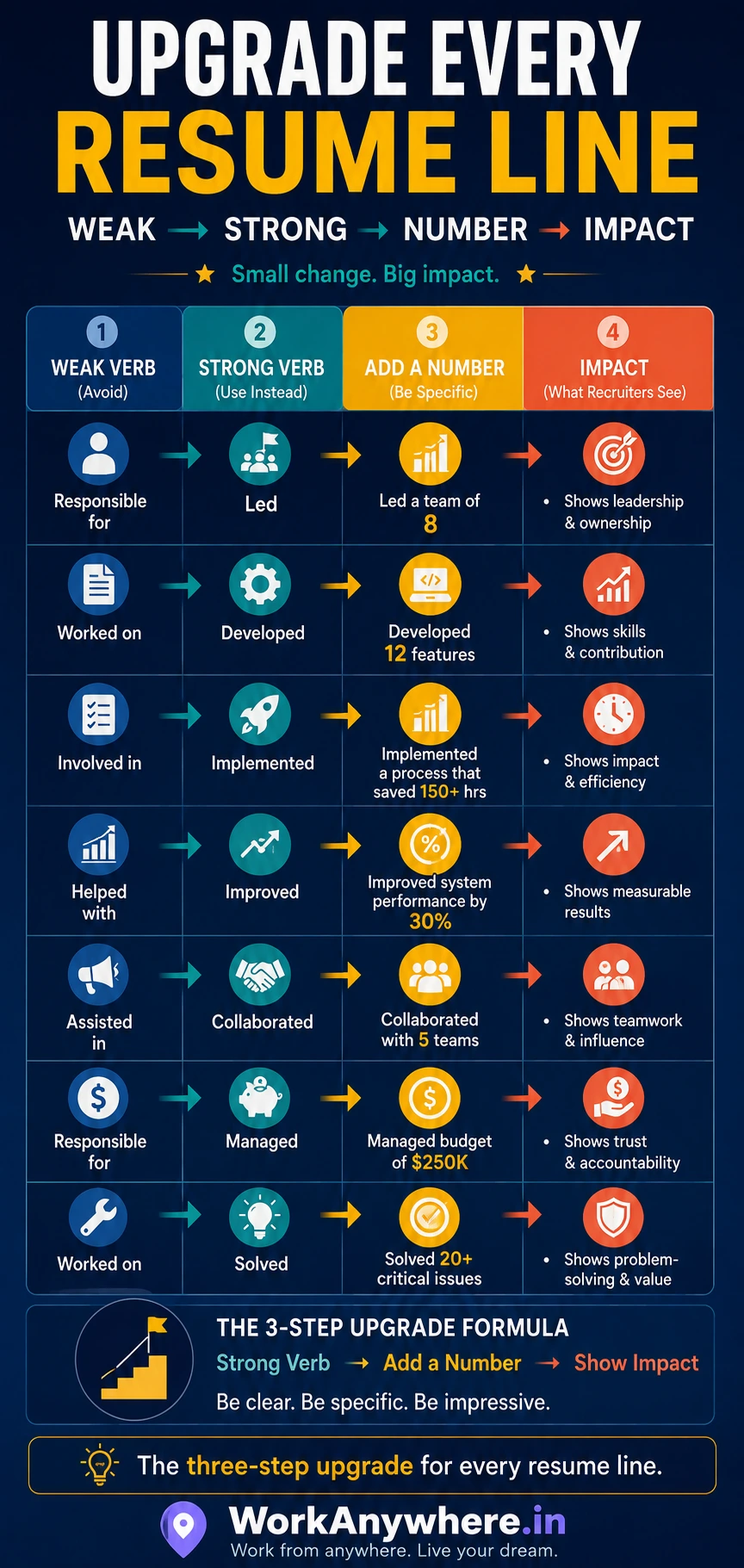
Verbs alone aren’t magic. Verb + result + number is the formula that works.
| Weak (Before) | Strong (After) |
|---|---|
| Responsible for social media | Grew Instagram from 500 to 8,000 followers in 6 months |
| Worked on customer support | Resolved 40+ daily tickets with a 4.8/5 satisfaction score |
| Helped with the sales process | Closed ₹25 lakh in new business in Q3 |
| Handled a team | Led a 5-person team through a product launch |
| Did data entry | Processed 1,000+ records weekly with 99% accuracy |
Notice the pattern: strong verb first, real outcome second, a number wherever possible. Even one number makes a bullet twice as believable.
The Mistakes That Undo Good Verbs
| Mistake | Why It Hurts | Fix |
|---|---|---|
| Repeating “Managed” 8 times | Reads lazy and flat | Vary verbs across bullets |
| Strong verb, no result | Sounds like a claim, not proof | Add a number or outcome |
| Fancy word you can’t defend | Interviewers will probe it | Only use verbs you can back up |
| Past tense for a current job | Looks careless | Use present tense for your current role |
💡 Pro Tip: No numbers for your role? You still have them. Count the tickets, the people, the events, the percentage, the time saved. “Organized 12 events” beats “organized events.” Freshers — use project and internship numbers. They count.
⚠️ Warning: Don’t Inflate. “Spearheaded a company-wide transformation” when you updated a spreadsheet will collapse the moment I ask about it in the interview. Strong verbs must match real work. Honesty scanned in 7 seconds beats exaggeration exposed in 7 minutes.
Your 3-Step Action Plan
- Open your resume. Highlight every “responsible for,” “worked on,” “helped with,” and “handled.”
- Replace each with a verb from the table above that matches what you truly did.
- Add a number to every bullet you can — people, percentages, money, time, or volume.
Fifteen minutes. That’s all it takes to make a resume sound like a top performer’s.

Key Takeaways
- Start every bullet with a strong action verb, never “responsible for.”
- The winning formula is verb + result + number.
- Vary your verbs — repeating “managed” reads flat.
- Only use verbs you can defend in an interview.
- Numbers make weak bullets believable and strong bullets unforgettable.
Ready to put these verbs to work? Create an ATS-friendly resume using Smart Resume Studio on WorkAnywhere.in — it helps you phrase achievements the way recruiters want to read them — and improve your chances of getting shortlisted for your next opportunity.
Frequently Asked Questions
What are the best action verbs for a resume? The best ones are specific and results-focused: led, built, launched, increased, reduced, achieved, delivered, and resolved. Choose the verb that matches your real contribution, then follow it with a measurable outcome.
Should every bullet point start with an action verb? Yes. Begin each bullet with a strong verb instead of “responsible for” or “I.” It makes your resume active, easy to scan, and focused on impact — exactly what recruiters look for in their first few seconds.
What words should I avoid on my resume? Avoid weak, vague fillers: “responsible for,” “worked on,” “helped with,” “handled,” and “duties included.” They describe presence, not results. Replace them with action verbs tied to real numbers.
Do action verbs help with ATS screening? Indirectly, yes. Strong verbs paired with job-description keywords make your bullets both machine-readable and recruiter-friendly. The ATS matches keywords; the verb makes the human who reads you next want to call.
How many different action verbs should I use? Vary them across your resume — aim for a different strong verb on most bullets. Repeating “managed” or “led” throughout reads flat. A mix signals range and keeps the reader engaged.
Can freshers use strong action verbs without work experience? Absolutely. Use them for projects, internships, and volunteering: “built,” “organized,” “presented,” “researched.” Back each with a number, like “organized a fest for 200 students.” Real effort counts, degree or no degree.
More from Remote Guide